

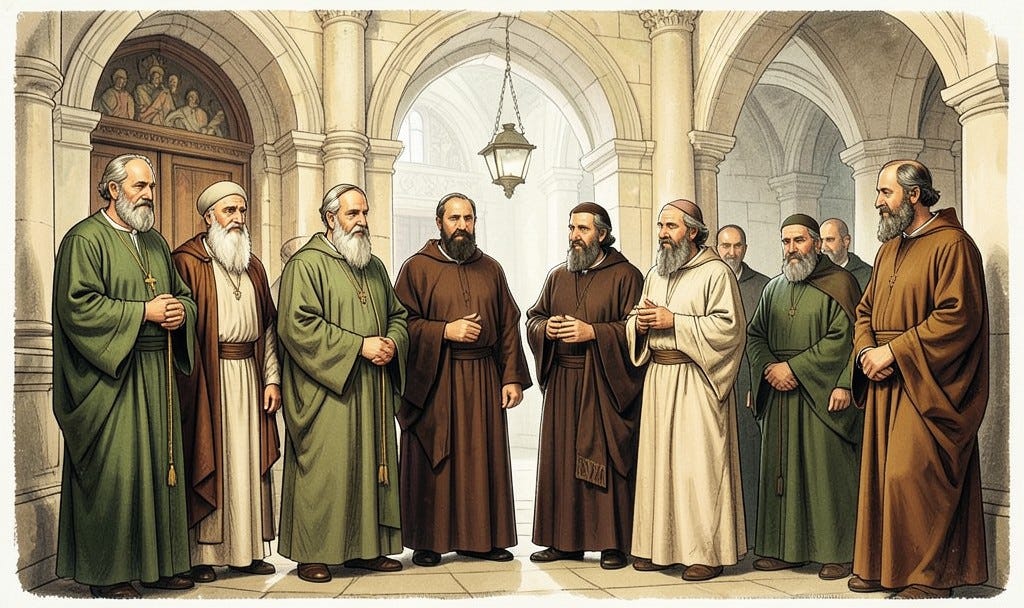
One of the questions I’ve often been asked when I discuss scriptures with people is this:
“How do you say the Fathers and those who have believed and preached this truth are wrong for all these years?”
But one thing I often tell them to ponder is this:
For years, the Christian world didn’t know that anyone could come to God directly and be saved, even though it was written boldly in Scripture.
During the dark ages, no one was declared righteous until they had received communion or sacrament. Not until the Protestants and Lutherans broke out did believers know that all one needed to be saved was to believe in Jesus.
Guess what?
To the folks of those days, Lutherans were saying that the Fathers of the faith at that time were all in error.
And what is more interesting?
They were right. The Fathers of the faith of those days were truly in error.
Today, receiving Jesus by simply believing is a “common thing”, because there were people who stood their ground to fight for it, although they were called progressive.
I am not presuming that the Fathers of the faith today are in error.
I am saying the argument that says:
“A belief or teaching in scriptures that has been in existence for centuries cannot be wrong in 2026” is wrong.
A “truth” can be wrong in any year. It only takes someone to shed more light on anything you call truth, and if it stands the test of Scripture, it can be right, even though it was “discovered” by a school dropout from Ajegunle in 2026.
Longevity does not make anything right or wrong.
Do you know how many years the church persisted in the errors of the RCC before the time of the Protestants?
I did some brief research in 2024, and it gave me about 1192 years. For over a thousand years, the church persisted in error. 1000 solid years, people were paying penance and didn’t “know” that justification was by faith alone.
1000 years!
Imagine if Luther had listened to those who said, “You cannot be right in 1517 for something that was agreed upon in 325 AD.”
All of us today would still have been paying something and receiving communion to be saved.
And guess what?
God won’t do anything. He will sit and wait until someone finally arises. This is one of God’s attributes that fears me. Years will come and go, and God is not about to break into the earth to do anything unless someone shows up. It’s his game. He will wait forever.
Ignorance does not exempt anyone from a thing. When your time on earth is done, you will still go the way of those before you. No, you’re not that special.
Long before Luther, there was another moment when a “settled” position had to be publicly overturned, and it happened while the apostles were still alive. Peter, James, and the rest had every reason to insist Gentiles first become culturally Jewish, circumcised, keeping the law, before they could be considered truly saved. That was the position. That was tradition. That was what “everyone” believed the gospel required.
Then Paul stood in front of the whole Jerusalem council and argued that circumcision added nothing to grace, and won. Read Acts 15 and Galatians together, and you’ll notice something:
The very first major theological dispute in church history was resolved by someone willing to say the accepted position, held by men who had literally walked with Jesus, needed correcting.
If that could happen while eyewitnesses of the resurrection were still breathing, why would we assume every later century somehow became immune to the same kind of correction?
And it isn’t only doctrine.
For centuries, respected churchmen insisted the earth stood still at the centre of the universe, and treated anyone who said otherwise as not just scientifically wrong but spiritually dangerous. Galileo wasn’t fighting scripture. He was fighting the comfort of a position repeated long enough to be mistaken for scripture itself.
History has a habit of doing this: dressing up “we’ve always said it this way” as though it were “God said it this way,” until someone is brave enough to ask for the actual verse.
So while I watched a video months ago where this dear woman was saying that if a church is “progressive,” they’re in error, she went ahead to list the things that make a church “progressive.”
I watched that, and I thought, “It is very difficult today to explain the meaning of words.”
“Progressive” is only wrong when used in the right context.
Today, no one knows what that context is, because each of us has our own unique definition of “progressive.”
When I realised that most theologians go to Bible school, learn these words, and yet interpret them differently, that’s when I knew that we are in trouble if we want to stick with WORDS!
So, grow beyond the nomenclature and really understand WHAT and WHO you’re dealing with. And by all means, never be afraid to question ANYONE and ANYTHING unapologetically.
You have only one life on planet Earth. Don’t waste it in self-inflicted ignorance.
Because here’s the uncomfortable part nobody tells you upfront: the very people paying penance for a thousand years weren’t lazy, and they weren’t stupid. Some of them loved God with everything they had. They simply inherited a system, trusted the men who taught it, and never thought to ask the one question that would have set them free decades sooner.
That’s the part that should actually unsettle you, not the doctrine itself, but how easily sincerity and error can sit in the same pew for a millennium without anyone noticing.
So the next time someone asks you how you dare say the Fathers were wrong, ask them gently what they think the Gentiles in Acts 15 would have said about the men who insisted they get circumcised first.
Ask them what a peasant in 1516 would have said about the priest telling him one more coin in the box would shorten his time in purgatory. Somebody was always sincerely, confidently, and traditionally wrong.
The only real question left is whether you’re willing to find out if it’s happening again in your own lifetime, or whether you’d rather stay comfortable and let someone else’s grandchildren be the ones who finally ask.