

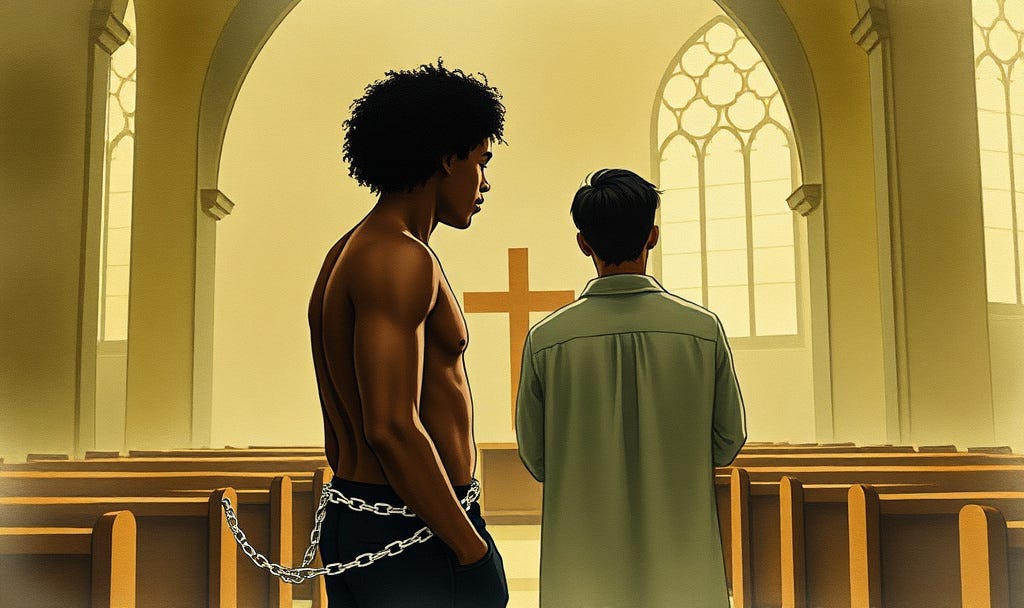
All things being equal, people do not become slaves by choice.
People become slaves either by:
Birth
War and conquest
Debt
Acts of violence
Punishment
Economic hardship and the need for survival, etc.
Humanity became slaves to sin and Satan by birth.
1 Corinthians 15:22: “For as in Adam all die...”
Then again,
Romans 5:12: “Wherefore, as by one man sin entered into the world,... and so death passed upon all men, for that all have sinned.”
Humanity after Adam did not have a choice to choose to become slaves to sin or not. They were all automatically made sinners.
Why?
Because the law of reproduction says that everything produces after its kind.
Job 14:4: “Who can bring a clean thing out of an unclean? not one.”
So, Adam produced after his kind.
Genesis 5:3: “And Adam... begat a son in his own likeness, after his image;...”
What was the image and likeness of Adam at this time?
Romans 5:12: “Wherefore, as by one man sin entered into the world,...”
So, Adam’s nature at the point he reproduced was sin. This means that you, who are born today, do not have the privilege to choose your slave master. By default, your first ancestor passed down his nature to you. The same way a child born to parents who are slaves automatically becomes a slave by birth, that is the same way we became slaves to sin by birth.
You didn’t fall from the sky. You have roots. Denying your roots because you don’t like them is not a smart way to achieve detachment.
What happens to a child born into slavery and sold to another master?
He becomes the slave of the new master.
War and conquest are also ways people become slaves.
If I invade your territory and take everyone captive, you automatically become my slave. Even if you strongly don’t want to be my slave, your strong will can only do very little to nothing.
I know you have rights. I know you have a will. But sadly, your will does not count. Your rights, at best, remain wishes in your mind.
What of your beliefs?
Well, you do not even have the right to believe anymore. Your beliefs will be conquered by my belief. Because I own you, including your beliefs. I will henceforth define what truth means to you. I will determine what morality and laws mean to you.
Not because you cannot develop your own belief system, but because you’re my slave. Your beliefs count for almost nothing. And at what point do you decide to leave? None.
You don’t get to leave until I say so. Your only chance of leaving my control is when I say so, or when a higher force overpowers me and sets you free.
It happened that, in the scheme of things, a man called Jesus did a number on a being called Satan who held all men in captivity through fear.
Jesus won and set the captives free. So, you are no longer a slave.
But this same Jesus now introduces a paradox to your existence.
He says:
You’re no longer a slave.
You’re still a slave.
So, even though you’re free from your former master, you’re now a slave in a new kingdom. But somehow, I think this new Master is good to us and our kind. Because He now says to us that we are not just slaves but sons. And perhaps this is where the paradox becomes beautiful. In His kingdom, two realities are operating at the same time.
1. To be in His kingdom, we are slaves, and so we do not have the right to simply walk away whenever we want.
We have been bought.
We have been transferred.
We now belong to another Master.
His will becomes the governing will over our lives.
We do not negotiate His authority based on whether His instructions are convenient for us.
2. But in His kingdom, we are sons, and so we can decide.
This is the strange thing about the kingdom of God.
The Master does not merely want servants who have no relationship with Him. He calls us sons. A slave obeys because he has no choice. A son obeys because he has come to know the Father.
A slave knows the master’s authority. A son knows the master’s heart. A slave is told what to do. A son is brought into the Father’s affairs.
And perhaps this is the freedom Christ actually came to give us. Not the freedom to have no Master, but the freedom to have the right Master.
Because the truth is, you will always be submitted to something.
Your desires can become your master. Your fears can become your master. Money can become your master. Society can become your master. Your past can become your master. Even your own understanding can become your master.
The question, therefore, is not simply, “Am I free?”
The deeper question is:
“Who owns me?”
Christ did not merely rescue us from one master and leave us without direction.
He brought us into another kingdom, under another authority, and then did something astonishing: He called us sons.
So we belong to Him, but we are not treated as mere property. We serve Him, but He brings us into His family. We obey Him, but He teaches us to understand His heart. We surrender our will, but He transforms our will until His desires become our desires. That is the paradox of Christian freedom.
We are slaves because we belong to Him.
We are sons because He belongs to us.
And perhaps true freedom was never the absence of a master.
Perhaps true freedom is finally belonging to the One to whom we were always meant to belong.