

One of the biggest significances of the Old Testament stories is that they help us understand what we have in Christ today. I dare say God played out physically (in the story of Israel) what he had prepared for us spiritually in Christ. In fact, if you study the Old Testament writings VERY WELL, you will understand more of the New Testament.
Starting from Abraham’s call.
Abraham was a native of Ur of the Chaldeans. He came from a world with its own gods, culture, and way of understanding reality. And then God called him to leave his native land for what would become the land of promise.
God told him he would give his descendants the land and bless him.
And from that moment, Abraham’s life became part of a much bigger story.
His descendants would eventually speak the languages of the places they inhabited. They would live in Canaan, Egypt, and other lands, carrying with them the story of a God who had called their father out of one world and into another.
I like to see that as a little picture of what happens to us spiritually.
We are translated from one kingdom into another, and then we “learn” to speak the language of our new home.
Anyway, God’s promise to Abraham was ultimately about more than physical land. Paul tells us that the promise had Christ at its centre. God taught Abraham (and through Abraham, all of us) about his ultimate plan in Christ through physical experiences, people, places and events.
That is one of the beautiful things about the Old Testament.
Physical stories were carrying spiritual realities.
Take Isaac, for instance.
The couple waited for years until every natural expectation seemed to suggest that Sarah could not have a child. And then Isaac came. The story itself became a testimony that God’s promise does not depend merely on human ability.
God is not the one who made Sarah barren.
Sarah was already barren before God called Abraham (Genesis 11:30). But God worked within that reality and used their experience to reveal something greater. God did not need to create the problem to teach through it. And that is something we should remember.
God does not orchestrate the difficult circumstances we experience. But he can (and he does) still teach us through them.
So, while Abraham waited for the promise, his understanding of God’s promise was also being developed. And Sarah, too, entered into that faith.
Hebrews says:
“Through faith also Sara herself received strength to conceive seed, and was delivered of a child when she was past age, because she judged him faithful who had promised.” — Hebrews 11:11
Sarah received strength because she came to trust the One who had promised.
And what was that promise ultimately connected to? The promise of blessing that would reach the nations.
The promise that Paul says was, in advance, the preaching of the gospel to Abraham:
“And the scripture, foreseeing that God would justify the heathen through faith, preached before the gospel unto Abraham, saying, In thee shall all nations be blessed.” — Galatians 3:8
Note that.
The gospel was preached to Abraham. And Abraham believed.
Jesus himself said:
“Your father Abraham rejoiced to see my day: and he saw it, and was glad.” — John 8:56
So Abraham’s life was not merely about a man looking for a piece of land. He was seeing something beyond himself.
His life was becoming a classroom.
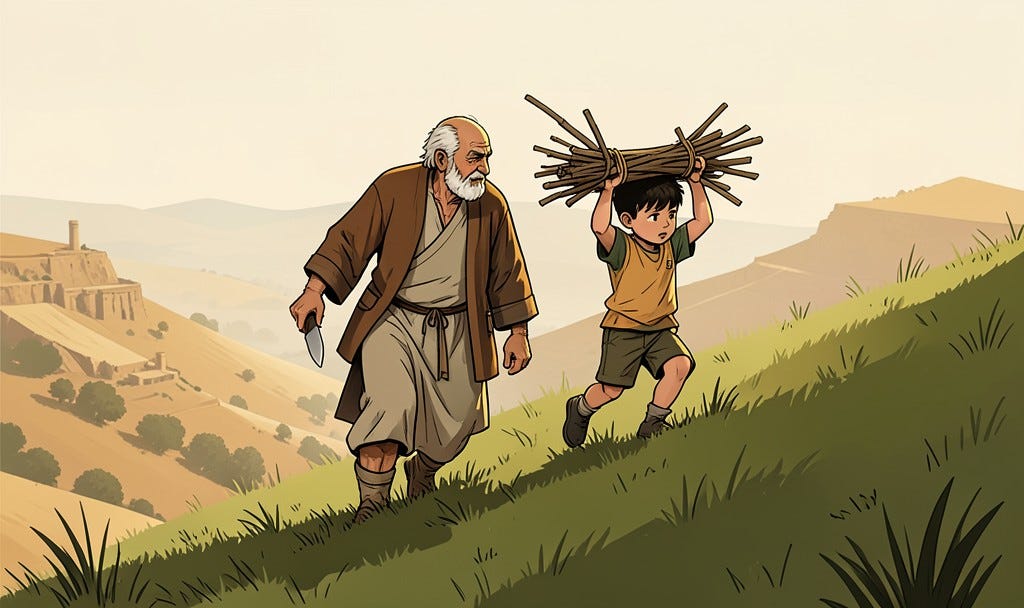
Abraham and Isaac
We see God “testing” Abraham’s faith. But I don’t think we should read this as though God were sitting somewhere wondering:
“Hmm. Let me see if Abraham will obey me today.”
God knows the heart. So he doesn’t need to do that.
So, what exactly was happening here?
Again, Abraham’s life was becoming a lesson. God was revealing something through the experience. The story of Isaac would paint a picture of Christ.
Look at it:
A beloved son is given.
The son is offered up.
A substitute is provided.
Isaac is received back, figuratively speaking, from death.
The writer of Hebrews tells us:
“It was by faith that Abraham offered Isaac as a sacrifice when God was testing him...” — Hebrews 11:17
And again, remember Abraham’s faith was connected to what God had promised him. He knew Isaac was the son through whom the promise would continue. So, if God was asking him to offer Isaac, Abraham reasoned that God was able to do something Abraham had never seen before.
Hebrews tells us exactly what he thought:
“Abraham reasoned that if Isaac died, God was able to bring him back to life again...” — Hebrews 11:19
This is why I don’t imagine Abraham as merely standing there, paralysed by uncertainty. The man had come to a conclusion about God. He believed the promise. And because he believed the promise, he believed that death could not have the final word over Isaac.
Did you read how this dude was ready to cut off his son’s head?
Nahhh ...
That guy was not just going through a random “test”. His mind was already made up. Guy drew out his knife. There was absolutely no doubt in his mind that Isaac would not simply be dead and gone. God had promised. And Abraham had come to trust the Promiser. So, perhaps this experience was doing more than measuring Abraham’s faith.
It was also revealing the content of that faith.
It was showing Abraham something about what God himself would do. God taught him about his plans in types and shadows. And Abraham’s response afterwards shows that he caught something.
After the ordeal where God provided an animal for the sacrifice, Abraham didn’t simply say:
“Oh God, thank you for sparing my son. Ahhh, I almost died of fear.”
No!
Rather, look at what he called the place.
“And Abraham called the name of that place Jehovah-jireh: as it is said to this day, In the mount of the LORD it shall be seen.” — Genesis 22:14
What was the revelation Abraham had caught earlier on?
God will provide.
Earlier in the story, Abraham had told Isaac:
“God will provide himself a lamb for a burnt offering.” — Genesis 22:8
And there, on the mountain, God provided a substitute. Isaac would not pay with his life. A ram took his place.
Can you see the picture?
Man will not ultimately pay for sin by saving himself. God will provide.
And that is what Christ is. God’s provision.
‘Jehovah-jireh’ comes from the Hebrew idea connected with seeing or seeing to something; hence the sense that ‘the Lord will see to it’ or ‘the Lord will provide’.
God used the whole scenario to teach Abraham that he would see to the provision humanity could not provide for itself.
And this truth was carried from generation to generation.
Genesis says:
“To this day, people still use that name as a proverb: ‘On the mountain of the Lord it will be provided.’” — Genesis 22:14
This was how generations learned to hope. The promise of God’s provision became ingrained into the consciousness of Israel. Their history carried it. Their sacrifices carried it. Their festivals carried it. Their stories carried it.
Something, or Someone: was coming.
That is why they lived hoping for the consolation of Israel.
But somewhere along the way, many began to focus more on the physical picture than the spiritual reality the picture was pointing towards.
And you can see why many were disappointed when Jesus came. They expected power. They expected political liberation. They expected a king who would overthrow Rome and restore visible national glory.
Instead, Jesus came as a servant. Born in humble circumstances. And he began talking about a kingdom that could not simply be reduced to physical territory.
“My kingdom is not of this world.” — John 18:36
They had the shadows. But many missed the substance. They had become so focused on what God had done physically that they struggled to recognise what God was doing spiritually.
They mistook the “blessing” to mean only WEALTH, POMP AND RULERSHIP.
But even Abraham and the other patriarchs understood that the promise stretched beyond the physical.
The writer of Hebrews says:
“But they were looking for a better place, a heavenly homeland. That is why God is not ashamed to be called their God, for he has prepared a city for them.” — Hebrews 11:14–16
They understood that they were looking for something greater. The physical journey was telling a bigger story.
And that brings me to another point I really want to make.
God can use your experiences
I believe God uses our experiences generally to teach us about himself. That does not mean God orchestrates every tragedy to “test” us. It does not mean every painful thing happening to you was sent by God as an examination. But it does mean that nothing has to be wasted.
God can use the tests we encounter in this world to teach us.
He can use failure to teach humility.
He can use disappointment to teach us where we placed our trust.
He can use loss to reveal what truly matters.
He can use difficult people to expose parts of ourselves we never knew were there.
He can use circumstances we would never have chosen to produce wisdom we may never have gained otherwise.
And sometimes, the lesson is not simply about the circumstance. Sometimes the circumstance reveals something happening within us.
How do we respond when things don’t go our way?
What does our pain reveal about what we believe?
What does our fear reveal about what we trust?
What does our anger reveal about what we expected?
I’m not saying every problem exists because there is a problem in your soul.
Life is more complex than that.
But I am saying that every problem can become an opportunity to look deeper.
Channel your hurts and circumstances into daring soul-growth projects.
Read.
Think.
Pray.
Learn.
Heal.
Ask difficult questions.
Become more aware of yourself.
Let what happened to you become material for the person you are becoming. The Old Testament teaches us that God can take ordinary human experiences and make them point to something eternal. Perhaps we should learn to look at our lives with the same openness.
Not every painful experience is God’s doing. But no experience is beyond his ability to teach through. So, when you’re troubled, look beyond the physical challenge. There may be wisdom waiting beneath the pain.
You’re graced continually.