

No early apostle spoke about himself, defended his authority, and proved he was called as much as the Apostle Paul.
If you were looking for an early apostle who gave “stories” about himself just to pass across a message, it was Paul. Read 1 and 2 Corinthians, and you’d find tons of this.
Paul spoke about his conversion.
He spoke about his sufferings.
He spoke about his revelations.
He spoke about his work.
He defended his apostleship.
He even compared his labour with that of other apostles when the situation demanded it. Not because Paul was obsessed with himself. But because sometimes, your story is part of your message.
Now, we excuse Paul’s behaviour of speaking about himself, what he had done, or who he was because he was one of the early apostles who had direct contact with the apostles of Jesus. But it’s not written anywhere that those were the criteria for anyone to speak about themselves.
I am saying this because there is this tendency to “humble” yourself so much that you begin to think of yourself as entirely worthless and Jesus as entirely worthy.
This is not even scriptural.
Jesus being worthy does not require you to become worthless. God being great does not mean you have to hate what he made. In fact, there is something strange about constantly insulting what God has created in an attempt to worship God.
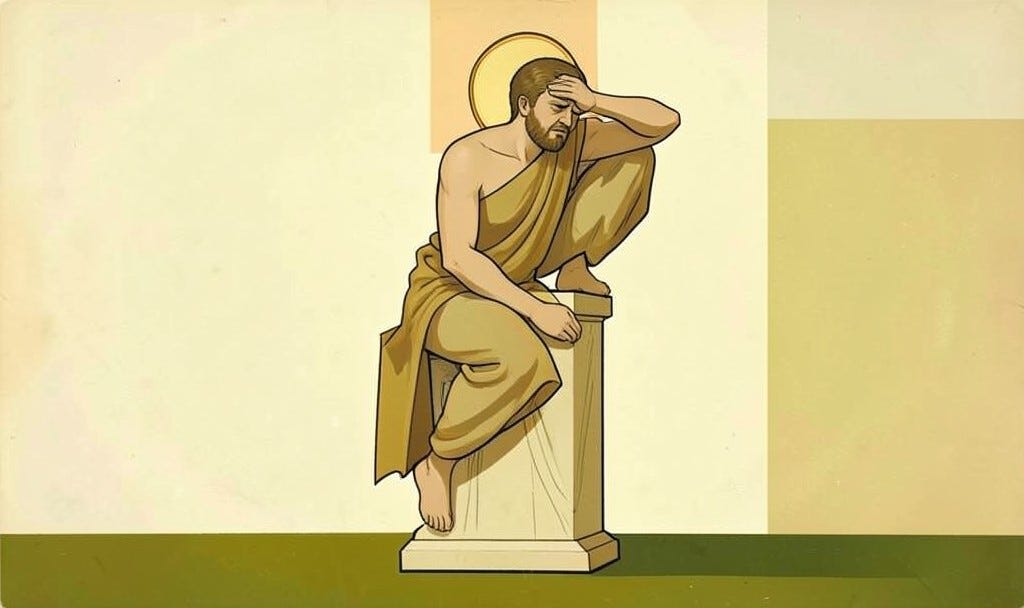
I once read of a mystic who consistently cried and called himself all sorts of names just to show how spineless he was and how great God is. One other Christian ascetic, Saint Simeon, would literally inflict pain on himself as a form of devotion to God. He lived for many years on a small platform atop a pillar.
That’s not all.
It is said that Saint Simeon would lie in very uncomfortable positions for long periods. These positions produced excruciating pain, but Simeon believed that this kind of suffering helped separate a person from base desires and set them apart for the service of God.
During periods of sickness, he reportedly subjected himself to further discomfort rather than seeking relief. He took asceticism to an extreme. Of course, many people were drawn to his lifestyle and sought spiritual guidance and counselling from him.
But why would someone think that afflicting themselves was a form of worship to God?
Just the same way someone once told me that fasting was a form of worship, and it didn’t quite sit well with me. I understand the importance of fasting and self-denial. I understand why we need discipline. I understand why we sometimes need to bring our bodies and appetites under control. But if we are not careful, we will begin to equate God’s benevolence with our works.
We will soon begin to think that the more uncomfortable we make ourselves, the more pleased God becomes with us.
Have you ever imagined that if God didn’t want to do anything for you, he wouldn’t do it simply because you afflicted yourself?
If he didn’t want to answer your prayers, for instance, no amount of suffering would force him to answer. If fasting could manipulate God, then God would no longer be God.
No, faith is not the hand that moves God.
Faith is believing in what God has already done and receiving the same.
But here is the caveat: most times, the journey towards appropriating all that God has given us can be rigorous and tough for our fickle minds.
This is why discipline matters. Not because discipline purchases God’s goodness. But because undisciplined people can struggle to walk in what has already been given to them. So, God led them through the wilderness rather than the cities.
Why?
Because they would see battles in the cities, become afraid, and turn back to Egypt. Their minds were not yet ready for certain battles. In that same manner, you fast, discipline yourself, and sometimes deny yourself things to bring your body under obedience.
You do these things not to bribe God into giving you something. You do them because you are on a journey, and sometimes you are the greatest obstacle standing in your own way.
You beat your body because you’re on a race to obtain something, and anything that stands in your way, you deal with it.
Paul himself used the imagery of an athlete who disciplines his body to avoid being disqualified (1 Corinthians 9:24–27).
The discipline is not the prize. The discipline helps you run the race.
So, how then does an extreme form of asceticism please God simply because you are going through unimaginable pain?
How does it make God happier that you’re suffering because you think suffering itself is a form of worship? And how then do you think seeing no worth in yourself is God’s plan for you?
Humility is not self-hatred.
Humility is not pretending you have no gift when you do.
Humility is not denying what God has done in you because you’re afraid someone might think you’re proud.
Humility is simply seeing yourself truthfully.
No more. No less.
How do you think you cannot use your stories and life to draw men closer to God? Paul did. The Scriptures are filled with people whose lives became part of the testimony. Their failures were recorded. Their victories were recorded. Their doubts were recorded. Their encounters with God were recorded.
So, the next time you hear people say, “preach Christ, not yourself,” first, check to be sure they are not speaking from a glorified form of asceticism. Of course, there is wisdom in that statement. Christ must remain the message.
But preaching Christ does not mean pretending that Christ has not done anything in your life.
You are not worthless.
Paul called his teaching about Christ, “my gospel.” (Romans 2:16; 16:25). And that’s what we read today. Paul did not invent the gospel. But he had encountered it. He had received it. He had preached it. It had become part of his life. So he could call it “my gospel” without replacing Christ with himself.
If your stories perfectly portray Christ, draw people closer to God, and are not void of the message of the gospel, then by all means, infuse them into your teachings. Don’t be afraid to talk about what God has done for you.
But don’t replace the gospel with stories.
Let’s hear the power of the gospel, and let’s also hear the good things that Christ has done through your life. Your story is not the gospel. But your story can be a testimony to the gospel. Stop thinking that when you speak of experiences that are biblical, you’re automatically “praising” yourself.
Well, if you still think this way, you probably should not be telling us your stories then. Because if you intend to praise yourself, people will eventually hear it. But if your intention is to testify about what God has done, don’t hide the testimony because you are afraid of looking proud. After all, what we read in the Old Testament are the lives and stories of men and women who walked with God.
Abraham’s journey.
Joseph’s story.
Moses’ encounters.
David’s failures and victories.
The stories are human.
But through those human stories, we see God. And this is also applicable to young people who are called but are not bold enough to abide by their “titles”.
If you only listen to and read sincere men of God who, in a bid to curb errors, constantly talk down on young people who are called, making mockery of “apostles”, “prophets”, and every other title, you’d never be bold enough to assume your office and do the Lord’s work.
So, someone is called by God as an apostle, for instance, and says, “No, I don’t want to answer to the title of an apostle. I just want to be Brother.”
My brother, you’re not obeying the one who called you. The title is not necessarily an honourific. At its best, it is a description of your role and office. And if that is genuinely the office God has entrusted to you, denying it does not make you humble. It can simply make you afraid of people.
How do you think Paul would have felt after persecuting the church and then calling himself an apostle? Imagine the irony. The man who once persecuted the followers of Christ is now standing before people and saying, “I am an apostle.”
That couldn’t have been easy.
But Paul knew who gave him his assignment.
He knew his calling was not a popularity contest. And he would rather please God than men. If you’re called as a prophet, no matter how much the office of the prophet is being ridiculed, wear your office with “pride.” Not pride in yourself. Pride in the sense of refusing to be ashamed of what God has called you to do. You’re honouring the Lord. You’re not serving man. You don’t need to exaggerate your title. You don’t need to force people to call you anything. You don’t need to use an office to control people. But neither should you shrink from your responsibility because humility has been wrongly defined for you.
There is a humility that makes a man kneel before God. And there is a false humility that makes a man hide from the assignment God gave him. Learn the difference.
Because Jesus being everything does not mean you are nothing.
You are what you are because of him.
And there is no humility in denying what grace has made you.